Build vs. buy: custom software or an off-the-shelf tool?
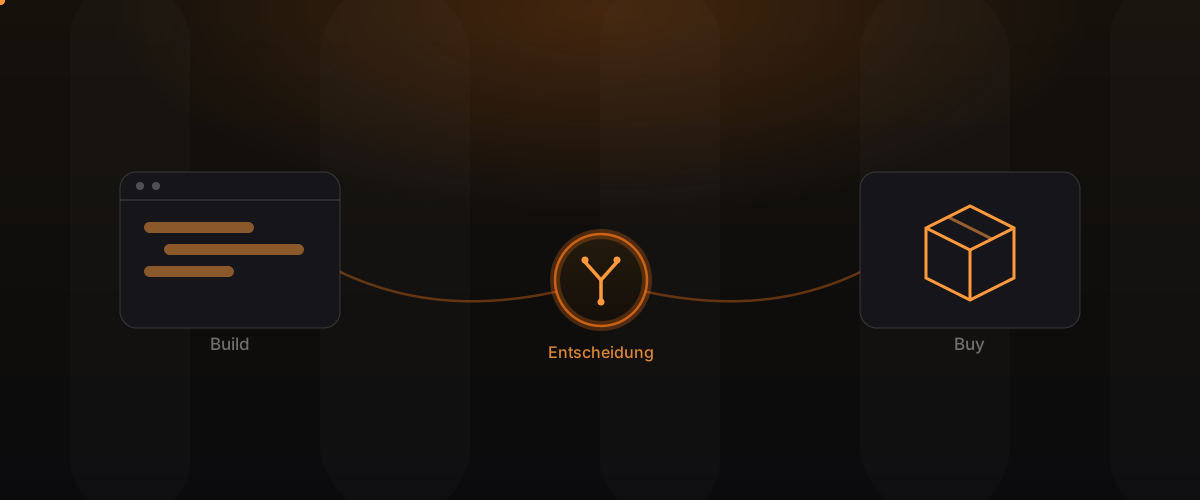
Few questions come up in product decisions as often as this one: do we build it ourselves or buy a ready-made tool? Both answers can be right, and both can be expensively wrong. The mistake rarely lies in the choice itself, but in making it by gut feeling. Build vs. buy isn’t a matter of belief, it’s a calculation with one clear guiding principle.
Key takeaways
- Build what sets you apart from competitors. Buy what’s commodity.
- The true cost of a tool isn’t on the price tag, it’s in the follow-on costs.
- Off-the-shelf tools are strong as long as your requirement matches the standard.
- Hybrid paths are often the best answer: buy what you can, build what counts.
What the decision is really about
The question “build or buy” sounds like a technical trade-off, but it’s a business one first. It’s not about what’s feasible, but about where your time, money and attention have the greatest leverage. Every hour your team spends rebuilding standard functionality is an hour missing from building what makes your product unique.
That’s exactly why the decision is rarely an either-or across the whole product, but a question you ask anew for each individual building block. Authentication, billing, sending emails: three building blocks, three possible answers.
The core rule: build the differentiator, buy the commodity
The most useful principle here is: build what sets you apart from competitors, and buy what everyone needs the same way. Your core differentiator is the reason customers come to you rather than the competition. Building it yourself means keeping control over exactly what creates your value.
Standard tasks, on the other hand, from sign-in to sending emails to processing payments, are the same for nearly every product. Building them yourself creates no advantage, it only ties up effort and responsibility. Here a good ready-made tool is almost always the better choice.
Total cost of ownership: the true price
The biggest mistake in the comparison is seeing only the obvious costs. When buying, the price seems clear: the monthly fee. When building, it seems to be the effort of development. Both fall short, because the real costs arise over the entire lifetime.
Build it yourself, and you pay not only for development but for ongoing upkeep: fixing bugs, keeping it current, evolving it. Buy it, and you pay not only the fee but tie yourself to a vendor whose pricing, roadmap and survival lie outside your control. An honest calculation accounts for both sides over years, not over the first month. That long-term view is also why we choose boring technology over whatever is newest.
Where off-the-shelf tools shine
Ready-made tools are widespread for good reason. For a clearly defined standard task they’re usually mature, maintained and ready to use immediately. They save you months of development, bring proven solutions to edge cases you’d only think of after the damage, and are evolved by a vendor whose entire business is exactly that one building block.
As long as your requirement matches what the tool was built for, buying is almost always the faster and cheaper choice. The decisive part is that “as long as”.
Where off-the-shelf tools hit their limits
A ready-made tool is built for the average case, not your special case. As long as your requirement stays within bounds, it fits. The moment you need something the vendor didn’t anticipate, the fight against the tool begins.
The typical limits: the tool can’t be customised the way your process demands. Integrating it into the rest of your system gets more awkward than expected. Or the tool covers ninety percent, and the missing ten percent are exactly the ones that make up your value. At that point the calculation shifts: what began as a shortcut becomes patchwork that ties up more effort than a targeted in-house build would have cost.
Build vs. buy at a glance
| Criterion | Build it yourself | Buy a ready-made tool |
|---|---|---|
| Speed to start | slower | fast, usable at once |
| Customisability | full | within the vendor’s bounds |
| Ongoing responsibility | yours | the vendor’s |
| Dependency | low | tied to the vendor |
| Sensible for | core differentiator | standard tasks |
The hybrid path
In practice, the best answer is rarely pure build or pure buy, but a deliberate mix. You buy the standard building blocks everyone needs the same way, and invest your own development where your product differentiates. That gives you speed on the mandatory parts and control on the parts that matter.
The key is to integrate the bought building blocks so they stay replaceable. If your own code doesn’t depend directly on a vendor’s quirks, but talks to it across a clear boundary, you can switch later without rebuilding half the product. That separation is the same discipline that makes a product viable from day one, as we describe in Shipping an MVP without cutting corners.
Lock-in: the underrated cost trap
The biggest hidden price of buying is dependency. The deeper a tool is woven into your product, the more expensive a later switch becomes. If the vendor raises prices, changes terms or discontinues the product, you’re stuck, unless you planned ahead.
Lock-in can’t be fully avoided, but it can be limited. The key levers: are your data in a format you can export? Does your code talk to the tool across a clear, replaceable boundary? And is the building block important enough that a switch would even be realistic? Ask these questions before buying, and you buy with open eyes instead of binding yourself blind.
The time factor: fast today, viable tomorrow
One dimension is often overlooked, even though it tips the balance: time. A decision that looks cheap today can turn expensive tomorrow, and the other way round. If you’re early in product development and need to learn fast, you’re often better off with bought standard building blocks, because they work immediately and let the team focus on the core. In this phase, speed is worth more than perfect control.
As you grow, the calculation sometimes reverses. What began as a bought building block becomes a brake under rising user numbers, harder requirements or new edge cases, and a targeted in-house build suddenly adds up. The good news: if you keep the bought parts replaceable from the start, you don’t have to make this decision forever. You buy for today and reserve building for tomorrow, without blocking the path.
A short decision aid
When you face the question, a few points help bring clarity. Is the building block a core differentiator or a standard task? Is there a mature tool that genuinely covers your concrete requirement, not just roughly? How high would the follow-on costs be over several years, on either path? And how hard would a later switch be? The answers rarely produce a gut feeling, but a reasoned decision.
Frequently asked questions
What does total cost of ownership mean? The total cost over the whole lifetime, not just the purchase price. For building, that includes ongoing upkeep; for buying, the fees plus the cost of dependency.
Should you lean towards buying for an MVP? Often yes, for standard building blocks like sign-in or billing. That gets the MVP to its core faster. The core differentiator itself, on the other hand, usually belongs in your own hands.
What is lock-in and how bad is it? Lock-in is dependency on a vendor that makes switching expensive. How bad it is depends on how deeply the tool sits in your product and whether you can get your data out.
What if a tool can do almost everything, just not the decisive part? Then be careful. Those missing ten percent are often exactly the ones that make up your value. Here a targeted in-house build can be cheaper than bending the tool.
Can we switch from buying to building later? Yes, if you prepare for it. If code and data talk to the tool across a clear boundary, the switch stays feasible. If the tool is deeply woven in, it gets expensive.
How does Rheinwork help with this decision? We assess each building block by core versus commodity, follow-on cost and dependency, and recommend the path that adds up for your product, not the one that simply sounds modern.
Conclusion
Build vs. buy isn’t a question of principle, but of arithmetic. Build what sets you apart, and buy what’s commodity. See the costs over years, not over the first month, and keep an eye on dependency. Most often the best answer is a deliberate mix of both: buy what you can, build what counts.
Learn more on SaaS Engineering and Software Engineering. Related post: Shipping an MVP without cutting corners.