First-party data and attribution that actually adds up
Every marketing budget decision rests on a single assumption: that the numbers you are looking at reflect reality. That assumption has been crumbling for years. Third-party cookies are disappearing, browsers are restricting tracking, and users move between devices without your reports stitching that together cleanly. The result is that channels look worse or better than they are, and you allocate money based on a distorted picture. First-party data is the route back to a data foundation that belongs to you, stays stable over time, and supports attribution you can actually trust. This article is written for decision-makers, not developers, and explains what matters without the jargon.
Key takeaways
- First-party data is the data your visitors share directly with you, collected through your own domain and infrastructure rather than through third parties.
- With third-party cookies going away and browser rules tightening, it shifts from a nice-to-have to the basis of reliable measurement.
- Server-side collection turns fleeting browser signals into your own, durable data foundation.
- Only on that foundation does attribution produce numbers you can genuinely base budget decisions on.
What first-party data actually is
First-party data is all the information that arises in the direct relationship between you and your users: page views, purchases, sign-ups, form completions, everything that happens on your own domain. It belongs to you, and you control how it is collected and used.
This is distinct from third-party data: information a foreign provider gathers about your visitors, often across devices and across many websites. That model sat at the centre of online advertising for years, and that model is now disappearing. Anyone who built their measurement on it loses not just data points but comparability over time.
Why first-party data matters right now
Several developments are converging at once. Browsers like Safari and Firefox already block third-party cookies by default, and even in the Chrome ecosystem the room for them keeps shrinking. Tracking protection and ad blockers cut off client-side scripts before they ever send a signal. On top of that come the requirements of the GDPR and a growing user awareness of what happens to their data.
In this situation, first-party data is not a trend but simply what remains and holds up. It is less prone to blocking, easier to reconcile with consent, and stays comparable over time. Those who build a clean foundation early keep optimising on solid numbers while others operate in the fog.
How server-side collection makes data first-party
Data is not automatically first-party just because it originates on your website. What matters is how it is collected. With classic, browser-based tracking, the script sends signals straight to third parties, and the browser shortens the lifetime of the related cookies, often to a few days. Returning users then get wrongly counted as new ones.
With server-side collection, capture runs first through your own infrastructure, ideally via a
first-party subdomain like data.your-domain.com. Fleeting, easily blocked browser signals become your
own, more stable data foundation that you control. How this setup works technically is covered in detail
in our guide to /en/blog/server-side-tracking/. For attribution, one thing matters above all:
this data is more complete and stays stitchable for longer.
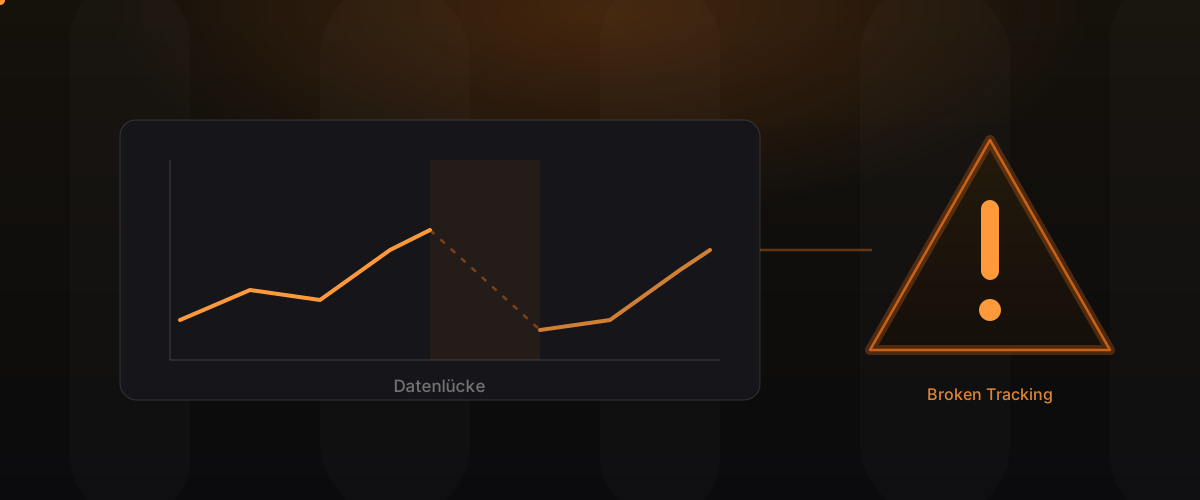
Why attribution breaks in the first place
Attribution answers a simple question: which channel, which campaign, which click led to a conversion? In practice the answer is rarely clean, and there are concrete reasons for that.
- Lost conversions: when signals go missing through ad blockers, consent or short cookie lifetimes, they go missing from the entire allocation. Successes simply get credited to no channel at all.
- Cross-device journeys: a user discovers you on mobile, researches on a tablet and buys on desktop. Without a continuous first-party basis, that one journey falls apart into three disconnected fragments.
- Long decision paths: in B2B or for high-value products, weeks pass between first contact and conversion. If the cookie lifetime ends before that, the start of the journey is lost.
The tricky part is that these gaps are not randomly distributed. They hit certain browsers, devices and audiences harder, and so they systematically shift the picture of which channels work.
Attribution models in plain terms
An attribution model is nothing more than a rule for how the credit for a conversion is spread across the contact points involved. Two terms come up again and again.
| Model | How it assigns credit | Weakness |
|---|---|---|
| Last-click | all the credit goes to the final contact point | ignores everything before it, favours conversion-near channels |
| Data-driven | spreads credit based on the actual paths across all contact points | needs complete, reliable data underneath |
Last-click is simple and widespread, but it hands the entire success to the final click. Channels that create awareness early in the journey end up looking systematically worthless. Data-driven tries to reflect the real contribution of each contact point. That is far closer to the truth, but it only works as well as the data beneath it. This is where the circle closes: without complete first-party data, even the best model produces only a nicely calculated distortion.
How to get attribution you can trust
Reliable attribution does not come from picking a model in the reporting tool but from a clean foundation underneath it. In practice that means a few but important steps.
- Secure collection: first, as little as possible should be lost. Server-side collection through your own domain is the lever with the biggest effect here.
- Wire in consent cleanly: what may not be collected must not be collected. A cleanly integrated consent mechanism ensures the remaining data is both reliable and legally sound.
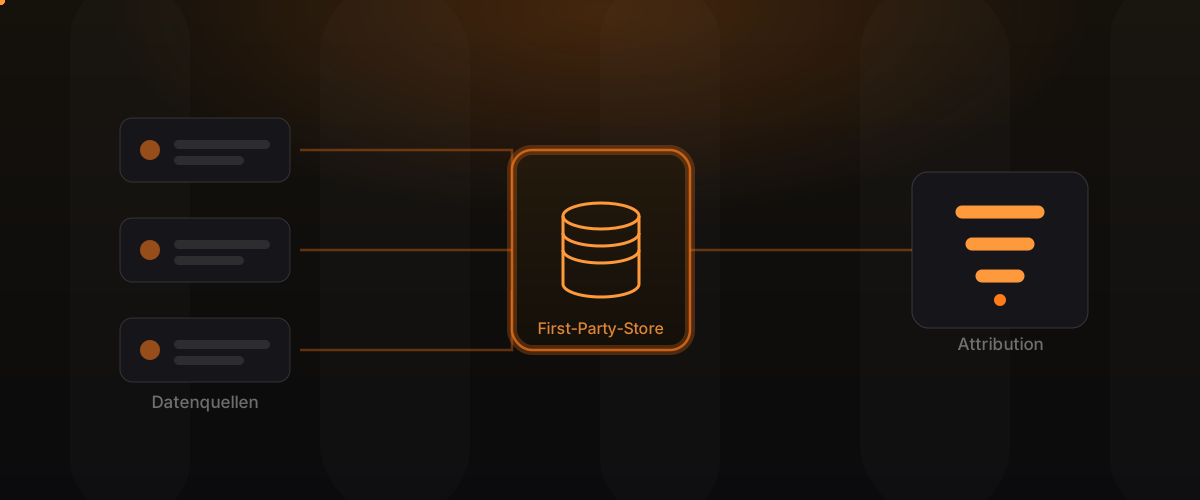
- Consolidate the data: signals from different sources belong in one shared, owned store, so that fragments become a coherent journey again.
- Choose the model deliberately: only once the data stands is the model choice a real decision rather than a cosmetic switch.
In order: the data foundation first, then the model. Anyone who tries it the other way round is optimising the presentation of a problem rather than the problem itself.
The direct line to your ad budget decisions
Attribution is not a reporting end in itself. It is the basis for where your money flows. When a channel looks worse than it is through lost or misattributed conversions, you cut its budget even though it is genuinely selling. Conversely, money flows into channels that only look good because they are credited with others’ successes.
With every reallocation, the error compounds: you shift budget based on distorted numbers, and the next report confirms the wrong decision. Reliable first-party data breaks that loop. You see what genuinely works and can steer budget to where it demonstrably produces revenue, rather than to where measurement happened to be complete.
What first-party data is not
So no false expectations arise: first-party data is not a trick to bypass consent, and not a licence to collect freely. On the contrary, it works so well precisely because it is transparent, self-controlled and compatible with the GDPR.
Nor is it perfect omniscience about every user. Cross-device journeys remain in part an approximation, and that is fine. The goal is not seamless surveillance but an honest, sufficiently complete foundation on which decisions become more reliable. That very modesty is what separates a solid data strategy from a promise no one can keep.
How to tell your attribution is misleading you
Before you invest, it is worth an honest look at typical warning signs in your reports.
- Conversions in your analytics tool and in your ad accounts differ significantly.
- A large share of conversions lands in the direct or unattributed bucket.
- Campaigns you know from conversations are working appear unsuccessful in the numbers.
- The journey from first contact to purchase looks unrealistically short.
If several points apply, your attribution is most likely incomplete, and every budget decision built on it is part guesswork.
Frequently asked questions
Is first-party data the same as personal data? Not necessarily. First-party describes the origin and control of the data, not whether it identifies a person. A lot can be collected in aggregate or anonymised. Anything that is personal of course remains subject to the GDPR.
Do I need first-party data if I only spend a little on advertising? The benefit grows with the budget, but the principle holds at small scale too: even with modest spend, wrong numbers lead to wrong decisions. The effort should match the size of what is at stake.
Does a first-party strategy remove attribution gaps entirely? No. It shrinks them considerably and makes the remaining picture more honest. A residual uncertainty, especially across devices, stays, but it can be accounted for deliberately.
Which attribution model is the right one for me? That depends on your channels and decision paths. More important than the model choice is that the data underneath is complete. With a good data basis, data-driven is usually the more honest choice than last-click.
Doesn’t consent cost me too much data for good attribution anyway? Consent reduces the volume of data, but cleanly collected first-party data still stays far more complete and stable than purely client-side tracking. The two are not mutually exclusive.
Isn’t this really a technical topic for IT? The implementation is technical, the consequences are not. Where your ad budget flows is a business decision. That is why decision-makers should understand what their numbers rest on.
Conclusion
First-party data is not a technical gimmick but the basis for ensuring your marketing decisions rest on reality rather than on a shrinking slice of it. When the data foundation is right, attribution turns from a source of constant doubt into a reliable tool with which you steer budget deliberately. We treat measurement as engineering, not as an afterthought.
Learn more on our Measurement Infrastructure page. Related: Server-side tracking: the complete guide and Server-side GTM and GA4 set up cleanly.