Headless commerce explained
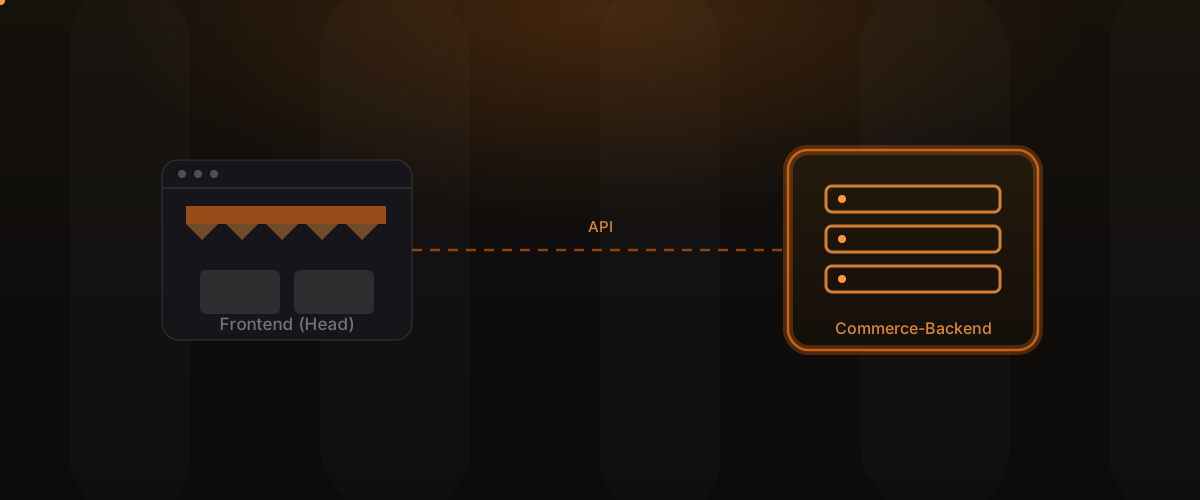
In classic online shops, the storefront and the shop logic are firmly built together: one system delivers the shop window and at the same time manages products, prices, cart and orders. Headless commerce deliberately separates these two worlds. The frontend, that is, what the customer sees, is decoupled from the commerce backend, and the two communicate over an interface. From the perspective of decision-makers, this article explains in plain terms what is behind it, which benefits and which downsides it has, and when the approach is genuinely worth it.
Key takeaways
- Headless commerce separates the storefront (frontend) from the shop backend, connected by an API.
- The biggest gains are in speed, design freedom and the ability to serve several channels from one source.
- In return, complexity rises: two systems instead of one want to be built and maintained.
- For many smaller shops a classic all-in-one system is the better choice; headless pays off above a certain size and ambition.
What does “headless” even mean?
The term sounds more technical than it is. “Head” here stands for what the customer sees: the product pages, the search, the cart, the shop window. “Headless” simply means that this visible part is decoupled from the system underneath. The backend that manages products, prices, stock and orders keeps running but now only hands out its content as data, instead of rendering pages itself.
Think of it like a restaurant: the kitchen (the backend) cooks and manages the ingredients. The dining room (the frontend) decides how things are served, in what setting and on what tableware. In a classic shop, kitchen and dining room are the same, inseparable building. With headless commerce they are separate, connected through a clear serving hatch, the interface.
How the frontend works with the backend
The link between the two worlds is an API, that is, a defined interface. The frontend asks the backend: “give me the data for this product”, “add this item to the cart”, “start the payment process”. The backend responds with pure data, and the frontend decides how to present that data.
This setup has an important consequence: the backend no longer has to care how something looks, and the frontend no longer has to care how orders are managed. Each side can do what it does best. That is the core of the approach and at the same time the reason for most of its benefits.
Benefit speed: a frontend without ballast
Because the frontend is no longer tied to the technology of the shop system, it can be built with modern, fast tools. It loads only what is really needed, instead of dragging along the full ballast of an all-in-one system. The result is usually significantly better load times and stronger Core Web Vitals.
In e-commerce this pays off directly, because speed acts on conversion. A fast, lean frontend is one of the most convincing reasons to consider headless at all. How closely speed and revenue are linked is something we describe in detail in the article on shop performance.
Benefit design freedom
Classic shop systems set a frame: themes, predefined structures, limits where the design ends. As soon as you want something of your own, you fight against the system. With headless commerce the frontend is free. It can be designed exactly the way the brand needs, without compromises to the technology of the backend.
For brands to whom a distinctive experience matters, that is a real difference. The shop window is no longer dictated by the tool but by your own vision. The technology subordinates itself to the experience, not the other way around.
Benefit omnichannel: one source, many channels
Because the backend hands out its content as pure data, any number of channels can be served from it: the website, an app, a point of sale in the store, a marketplace, even a voice assistant. They all draw on the same source for products, prices and stock. Maintain a product once, and it is up to date everywhere.
For companies that sell across several channels, this is one of the strongest reasons for headless. Instead of maintaining the same catalogue twice in several places, there is one central truth and many shop windows in front of it. Over time, that noticeably reduces errors and effort.
The downside: more complexity
As convincing as the benefits sound, they come at a price. Anyone who separates frontend and backend ends up with two systems instead of one, which want to be developed, operated and maintained. The interface between them must be well thought out, documented and stable. That requires more technical skill and usually more upfront investment.
A classic all-in-one system delivers a lot “out of the box”: checkout, payment integration, shipping, taxes, all pre-built. With headless, the frontend has to bring these building blocks together deliberately. That is not a disadvantage in itself, but it should be costed openly, instead of only looking at the benefits. This very trade-off leads straight to the fundamental question we cover in detail under /en/blog/build-vs-buy/.
When headless pays off, and when it does not
Headless commerce is not an end in itself. For a small, straightforward shop with a manageable assortment, a classic all-in-one system is usually the smarter and cheaper choice. The separation only pays off when certain requirements come together.
Headless typically becomes worthwhile when speed is business-critical, when a distinctive frontend that departs from the standard is needed, when several channels are to be served from one source, or when a shop grows so large that the limits of the all-in-one system become noticeable. Without these drivers, the extra complexity is rarely justified.
Headless does not mean “build everything yourself”
A common misconception is that headless means having to develop the entire shop backend from scratch. That is not the case. The backend can be an established commerce system that you deliberately use in its decoupled mode. Platform names appear here only as examples; what matters is the principle, not the individual product.
The actual effort shifts to the frontend and the clean integration. So you do not rebuild the whole restaurant, but mainly design the dining room freely and ensure a reliable connection to the existing kitchen. That puts the complexity into perspective without explaining it away.
The honest comparison: headless versus all-in-one
Both approaches have their place, and the right choice depends on size, ambition and resources. The following overview places the most important differences side by side, so the decision rests on a clear basis.
| Criterion | Classic all-in-one system | Headless commerce |
|---|---|---|
| Frontend freedom | limited by themes | almost unlimited |
| Speed | system-dependent, often medium | very high when done well |
| Several channels | laborious | possible out of the box |
| Upfront effort | low to medium | higher |
| Maintenance | one system | two systems plus interface |
| Best suited for | smaller, straightforward shops | ambitious, growing shops |
Frequently asked questions
Is headless commerce only for large companies? Not exclusively, but it leans that way. The benefits unfold above all where speed, design freedom or several channels are genuinely needed. For small, straightforward shops an all-in-one system is usually more fitting.
Will my shop automatically get faster? It only gets faster through good implementation, not through the “headless” label. The approach creates the precondition for a very fast frontend, but speed still has to be deliberately produced and measured.
Do I have to replace my existing shop system entirely? Not necessarily. Often an existing backend can keep being used in a decoupled mode and only the frontend is set up anew. Whether that makes sense depends on the state of the existing system.
Is headless more expensive than a classic shop? Up front usually yes, because two systems and the interface are created. Whether it pays off depends on how strongly you actually use the benefits, above all speed and several channels.
How long does implementation take? Longer than a standard off-the-shelf shop, because the frontend is built individually. Reliable statements are only possible per project, because scope, assortment and integrations are decisive.
Can I move from an all-in-one system to headless later? Yes, a gradual transition is possible, for example by decoupling the frontend first. The important thing is to plan the move cleanly, so that data, orders and rankings are preserved.
Conclusion
Headless commerce separates the storefront from the shop backend and thereby gains speed, design freedom and the ability to serve many channels from one source. The price is more complexity: two systems and an interface instead of one closed package. For ambitious, growing shops this can be exactly the right path; for smaller and straightforward projects, the classic all-in-one system often remains the smarter choice.
Learn more on E-Commerce Engineering and Web Engineering. On the fundamental decision: Build vs. buy: develop yourself or buy?.