Multi-tenant from day one: pitfalls and patterns
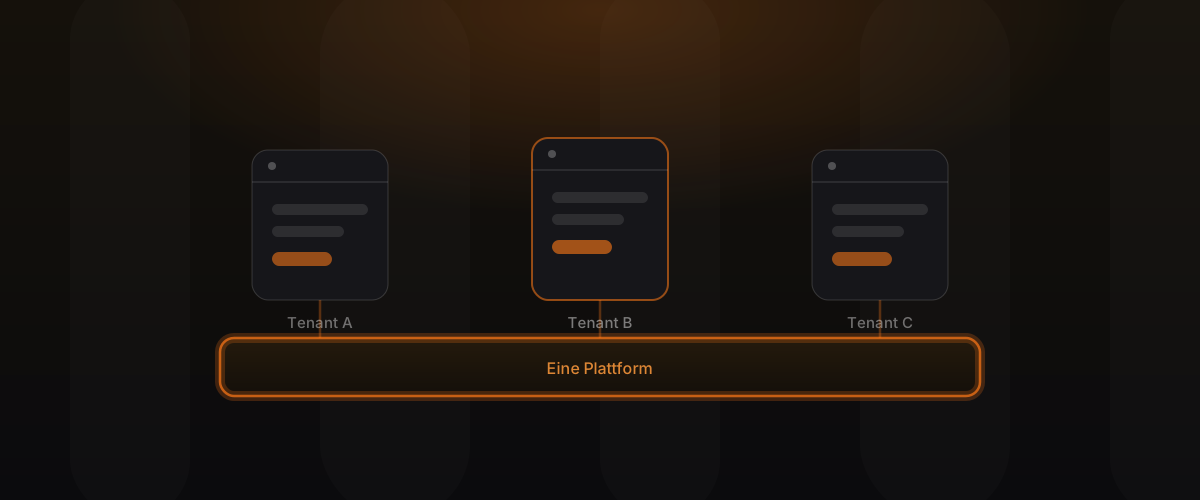
When many customers use the same application but each may only see their own data, we call that multi-tenant. It sounds like an implementation detail. In reality it’s one of the decisions with the longest shadow in your product: it shapes the data model, the security and the cost of the next few years. Make it too late, and you pay for it twice.
Key takeaways
- Multi-tenant means many customers, one application, strictly separated data.
- Retrofitting is expensive, because the separation touches every table and almost every query.
- There are several isolation models, from a shared schema to fully separate databases.
- The key question isn’t technical, it’s: how much separation does your market demand?
What multi-tenant really means
A tenant is a unit that sees its data fully separated from everyone else’s, usually a customer company with its own users. Multi-tenant means a single running application serves many such tenants at once, without any one ever seeing another’s data.
The appeal is obvious. You run one codebase, one infrastructure, and ship updates to everyone at once. That’s efficient, scales economically and is the standard for modern SaaS products. The price: the separation between customers is no longer a matter of the operating system or a separate server, it has to be reliably guaranteed inside the software itself.
Why retrofitting is so expensive
Multi-tenant isn’t a feature you bolt on later. It’s a property that touches almost every part of the system. If the separation is missing from the start, it affects every table that holds customer data, every query that reads those tables, and every place in the code that writes data.
Retrofitting is therefore rarely a small change. It means extending the data model, assigning existing data cleanly to the right tenants, and making sure that truly no query forgets the tenant. A single overlooked path is enough for one customer to see another’s data. That completeness is exactly what’s hard to guarantee after the fact. We describe just how high the price of a sloppy foundation gets in The hidden cost of a bad data model.
The isolation models at a glance
There’s no single correct multi-tenant. Instead there’s a spectrum, running from maximally shared to maximally separated operation. The three common models:
- Shared schema: all tenants share the same tables. Every row carries a marker for which tenant it belongs to. Efficient and simple to run, but the separation depends entirely on correct filtering in the code.
- Separate schemas: one database, but a dedicated namespace with its own tables per tenant. Stronger separation, somewhat more administrative overhead.
- Separate databases: each tenant gets its own database. The clearest separation, but also the highest operating cost and the most effort for updates.
Data security between tenants
In a shared schema, the separation is a software property, not a physical fence. That’s workable and widely used in practice, but it demands discipline: every query has to be reliably scoped to the right tenant, not in some places, but in all of them.
The robust path is not to leave this scoping to each individual query, but to enforce it centrally, so that forgetting it simply isn’t possible. That turns a question of diligence into a question of architecture. Carry the tenant by hand in every query instead, and you build yourself a source of errors that grows with every new feature.
Comparing the isolation models
| Criterion | Shared schema | Separate schemas | Separate databases |
|---|---|---|---|
| Data separation | logical, in code | stronger, per namespace | physical, per database |
| Operating cost | low | medium | high |
| Update effort | small, once for all | medium | high, per database |
| Scaling to many customers | very good | good | limited |
| Fits | many smaller customers | a mid number, clear split | few, with hard requirements |
When you need it from the start
The rule of thumb is simple: as soon as multiple customers will foreseeably run on the same platform, multi-tenant belongs in the foundation, even if only a single customer exists on day one. The first customer costs a clean setup almost no extra effort. The tenth customer, retrofitted afterwards, costs a rebuild.
There’s also the opposite case. If you’re building an internal application for exactly one organisation, with no prospect of further tenants, you don’t need multi-tenant and should leave it out. The art isn’t in pre-building everything, but in setting the points early where the market demands it. That’s the same logic as in Shipping an MVP without cutting corners: build small, but on a foundation that holds.
Common pitfalls
- Introducing the separation too late: the most expensive mistake, because it retroactively touches every table.
- Carrying the tenant by hand: one forgotten place is enough for a data leak.
- Choosing the wrong model: separate databases for hundreds of small customers make operations expensive and updates a chore.
- Mixing configuration and data: when tenant-specific settings live in code instead of in data, every new customer becomes a deployment.
More than data: what else has to be tenant-aware
Multi-tenant doesn’t end at the data model. The surroundings have to think along too. User management has to know which tenant a user belongs to. Billing has to be cleanly attributed per customer. Customisations like logo, domain or feature set belong controlled per tenant, not wired into the code. Even background jobs and analytics have to know on whose behalf they’re running. Thinking this through early avoids having to retrofit each of these places one by one later.
The cost question for decision-makers
From a leadership view, multi-tenant isn’t technical play, it’s a question of margin and risk. A cleanly built platform serves each additional customer at low marginal cost, because you keep running one codebase and one infrastructure. That’s exactly what makes the SaaS model economically attractive.
On the risk side sits data security. An incident where one customer sees another’s data isn’t just a bug, it’s a breach of trust that costs contracts and reputation. That’s precisely why it pays to solve the separation early and architecturally, rather than leaving it to diligence in day-to-day work. More on how we set this up at SaaS Engineering.
Multi-tenant and later growth
The real value of a tenant-aware architecture shows up as you grow. A new customer becomes a configuration, not a project. A shared update reaches everyone at once. And if a single large customer eventually demands stricter separation, exactly that customer can be lifted onto a stronger isolation model without rebuilding the whole platform. But that flexibility only exists if the separation was thought through consistently from the start.
Frequently asked questions
What’s the difference between multi-tenant and several installations? With several installations, each customer runs its own copy of the application. With multi-tenant, one application runs for everyone, with separated data. The latter scales more economically, but demands clean separation inside the software.
Which isolation model is the right one? It depends on your market. Many smaller customers argue for a shared schema, few customers with hard separation requirements argue for separate databases. We choose the model based on your concrete requirements.
Can we change the model later? Yes, but it’s easier to move from more shared to more separated than the other way round. That’s why we set up the logical separation cleanly from the start, even when we begin with a shared model.
Do I need multi-tenant for an MVP? Only if multiple customers will foreseeably run on the platform. Then it belongs in the foundation. For an internal application with exactly one organisation, it’s unnecessary effort.
How do you ensure no customer sees foreign data? By enforcing the tenant scoping centrally, instead of leaving it to each individual query. That way a developer can’t accidentally forget it.
What does multi-tenant cost? Thought through from the start, it costs barely more than an application for a single customer. Retrofitted afterwards, it becomes a rebuild project. That’s exactly the argument for doing it early.
Conclusion
Multi-tenant isn’t a feature you screw on, it’s a property that emerges in the foundation. Set right early, it costs barely more and makes every additional customer cheap. Retrofitted too late, it becomes an expensive rebuild with a security risk. The most important decision isn’t the technical model, but the honest answer to the question of how many customers your platform should carry.
Learn more on SaaS Engineering. Related posts: Shipping an MVP without cutting corners and The hidden cost of a bad data model.