Shop performance: why fast shops sell more
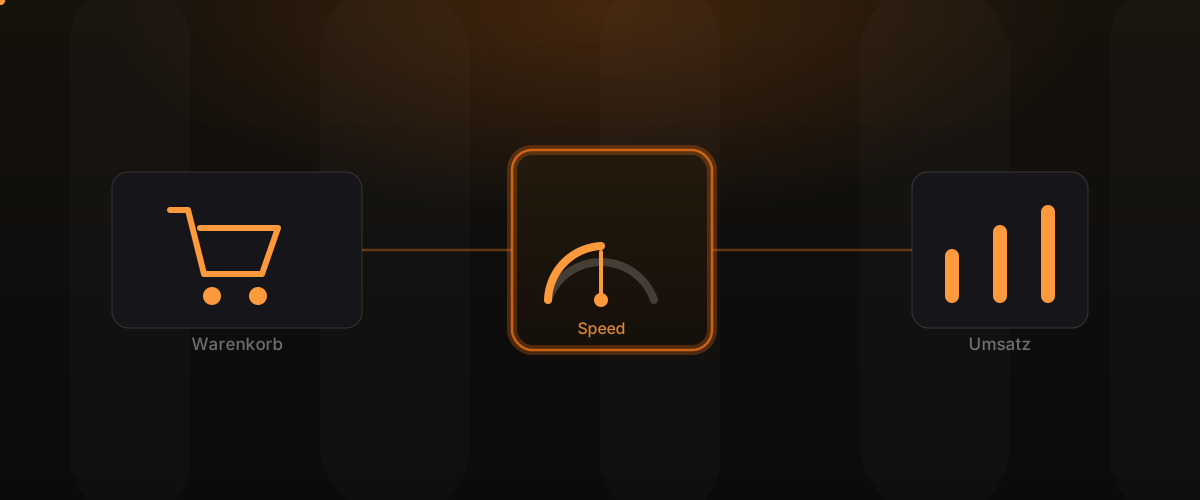
In an online shop, the purchase is often decided in the first few seconds, long before a customer has even properly seen the product. Shop performance is therefore not a technical detail but a direct revenue factor. A page that hesitates loses visitors at exactly the moment they are ready to buy. From the perspective of shop owners and decision-makers, this article shows how load time acts on conversion, cart abandonment and earnings, which levers really matter and how to measure the effect reliably.
Key takeaways
- Fast shops sell more: shorter load times reduce abandonment and raise the conversion rate.
- Core Web Vitals are especially critical for shops, because many images, scripts and tracking tags weigh the page down.
- Mobile shopping is the norm, and that is exactly where slowness hurts most.
- You can measure the effect: load time, conversion rate and revenue belong in the same analysis.
Why speed decides the sale
An online shop only sells if the visitor stays. And whether they stay depends in large part on how fast the page responds. Every extra second of waiting raises the chance that someone leaves, often before the first product image has even loaded. Unlike on a content page, the consequence here is immediate: no visit, no cart, no revenue.
The tricky part is that these losses are invisible. A visitor who bounces leaves no complaint, they are simply gone. That is exactly why many owners underestimate how much a slow shop actually costs. Speed is the quiet lever that, in the background, helps decide every single purchase.
The concrete cost of a slow shop
Run the numbers once: if a shop has a certain number of visitors per month and a noticeable share leaves because of long load times, that quickly adds up to many lost orders. At a mid-range cart value, this becomes an amount that often exceeds the cost of a performance optimisation many times over.
There is a second effect on top: paid traffic gets more expensive when the landing page is slow. You pay for every click, but a portion of those visitors never reach the actual shop because the page takes too long. Slowness therefore burns not only organic revenue but also advertising budget. Speed is thus one of the few measures that raises conversion and lowers acquisition cost at the same time.
Core Web Vitals for shops
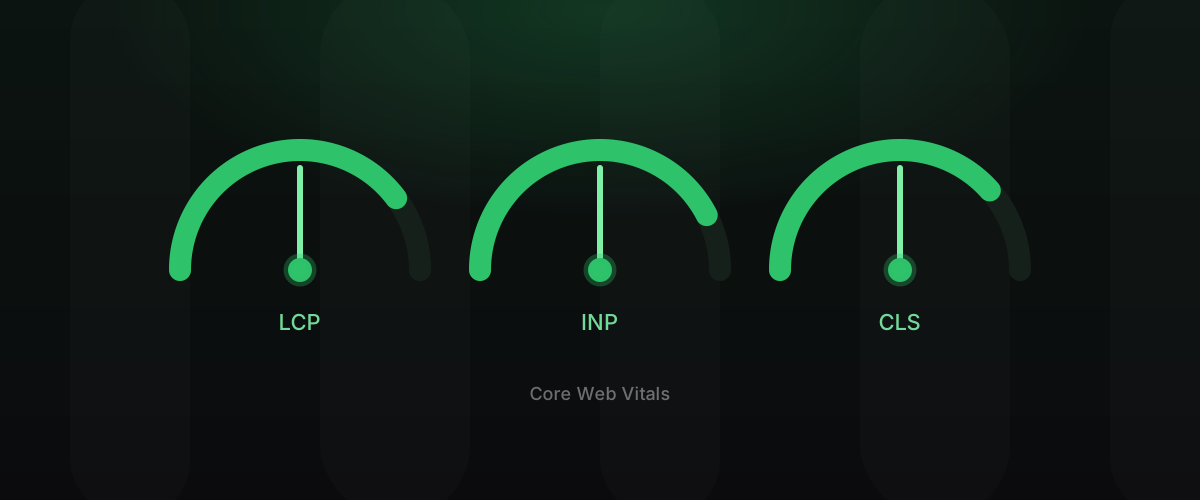
Google rates the user experience via the Core Web Vitals: loading time (LCP), responsiveness (INP) and visual stability (CLS). For online shops these values are particularly sensitive, because a shop typically loads many large product images, numerous scripts and several tracking tags at once. These are exactly the components that drag the values down when they are not kept under control.
A poor CLS value is especially annoying in a shop: if content shifts after loading, a customer taps the wrong product or the wrong button by accident. A sluggish INP value, in turn, means the click on “add to cart” feels heavy. Both undermine trust at exactly the point where money is involved. How to improve these values deliberately is something we describe in detail under /en/blog/improve-core-web-vitals/.
Mobile first: shopping in the hand
Most shop traffic today comes via smartphones, often over slower mobile connections and on less powerful devices. What still feels smooth on a fast office computer can become a test of patience on a phone on the train. And it is precisely there, on the move, between two appointments, that the willingness to wait is lowest.
Mobile performance is therefore not an add-on discipline but the real stress test. A shop that is fast on mobile is almost automatically fast on desktop too; the reverse is not true. Anyone who takes performance seriously optimises first for the device on which most purchases actually happen.
Images: the biggest lever in a shop
In most shops, images are by far the heaviest item. Product photos, galleries, lifestyle shots, all of it has to load before the page is ready. Unoptimised images are often many times larger than necessary and slow down the LCP value in particular, that is, exactly the metric the customer perceives as “feels slow”.
The good news: this is also where the biggest lever sits. Modern formats, the right sizes for each device, deferred loading of images further down the page and clean preloading of the most important image often bring the most noticeable jump, without losing anything in the design. Optimising images is rarely spectacular, but it is almost always the single most effective measure.
Scripts, tags and tracking under control
Online shops accumulate a surprising amount of scripts over time: analytics tools, chat widgets, review services, recommendation engines, several advertising pixels. Each one seems harmless on its own, but in sum they block the main thread and make the page noticeably sluggish, especially on mobile.
An honest inventory helps here: which tag genuinely adds value, and which only runs out of habit? What stays can often be integrated more cleanly, for example via server-side tracking that takes the load off the customer’s browser. That preserves measurement and marketing without performance suffering for it.
The checkout: where speed turns into revenue
If a customer makes it to the checkout, they are ready to buy, and this is exactly where slowness is most expensive. Every hesitating second, every clunky step, every page that has to reload between cart and payment is an invitation to abandon after all. A fast, frictionless checkout is therefore the area with the most direct revenue impact.
Speed is only half the job, though: the checkout must be not only fast but also stable and understandable. Clear steps, no surprising jumps in the layout, immediate feedback after each entry. Investing here captures exactly the customers who had almost bought already.
Performance and trust go together
A fast shop feels professional before a single word has been read. A page that is there instantly, loads cleanly and responds promptly to every click signals: someone here knows their craft. That lowers the barrier to entering sensitive data such as address and payment details.
Conversely, a sluggish, stuttering shop sows doubt. If even loading is shaky, how reliable is the delivery? How secure is the payment? Customers usually ask themselves these questions unconsciously, but they influence the buying decision. Performance is therefore also a trust signal, not just a technical metric.
Making the revenue impact measurable
So that speed does not stay a vague promise, the effect belongs in a concrete analysis. Do not measure load time in isolation; place it next to conversion rate, cart abandonment and revenue. Only this connection shows what an optimisation actually achieved.
A clear before-and-after comparison has proven its worth: record the current state cleanly, implement a measure, and measure the same period again. Tools like PageSpeed Insights or the Core Web Vitals in Search Console provide the technical values; a reliable shop analysis creates the link to orders and earnings. That turns “the page feels faster” into a solid statement about additional revenue.
What should be optimised first
Not every measure delivers the same value, and performance work only pays off when it starts in the right place. The following overview ranks the typical levers by effort and impact, so you know where to begin.
| Lever | Effort | Impact on conversion |
|---|---|---|
| Optimise images | low to medium | very high |
| Remove unnecessary scripts | low | high |
| Speed up the checkout | medium | very high |
| Move tracking server-side | medium | medium to high |
| Hosting and delivery (CDN) | medium | high |
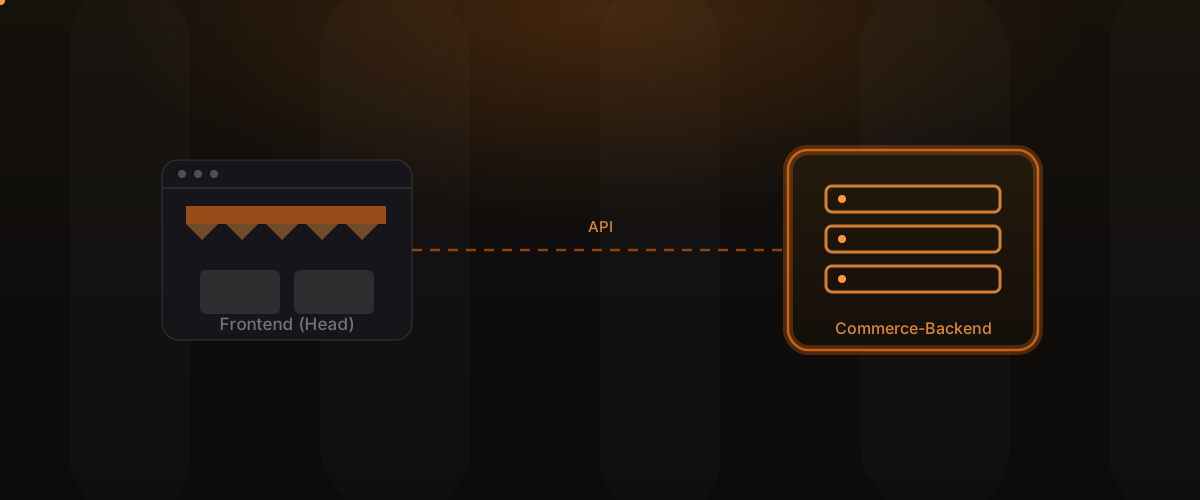
| Fundamentally modernise the frontend | high | high and lasting |
Frequently asked questions
How strongly does load time really affect revenue? The correlation has been documented for years: the faster the shop, the fewer drop-offs and the more purchases. How big the effect is for you specifically only becomes clear by measuring in your own shop, because it depends on assortment, audience and starting point.
What is the single most important measure? In most shops it is the images. They are the heaviest item and at the same time often optimisable with reasonable effort. Right after that come the checkout and clearing out unnecessary scripts.
Is it enough to optimise once? No. A shop changes constantly: new products, new tools, new campaigns. Performance is therefore not a one-off project but needs regular checks so the lead is preserved.
Do I have to give up features for speed? Usually not. It is rarely about cutting features, but about integrating them more cleanly: optimised images, considered loading and slimmed-down tracking keep the functionality and still improve speed.
Does a new frontend bring more than individual optimisations? That depends on the starting point. If the shop is technically outdated, a modern, fast frontend can bring the most lasting jump. Often, though, it pays to use the quick levers first and measure the effect.
How do I measure success properly? By not looking at load time in isolation but placing it next to conversion rate and revenue, in a direct before-and-after comparison over the same period. Only this connection makes the additional revenue visible.
Conclusion
Speed in an online shop is not a comfort topic but one of the most effective levers for more revenue. Fast shops lose fewer visitors, win more completed purchases and use their advertising budget more efficiently. The biggest levers, images, checkout and clean tracking, can usually be moved with manageable effort, provided you measure the effect properly.
Learn more on E-Commerce Engineering and Performance & SEO. On the topic of technical values: Improve your Core Web Vitals.