Shopify or a custom shop? An honest decision guide
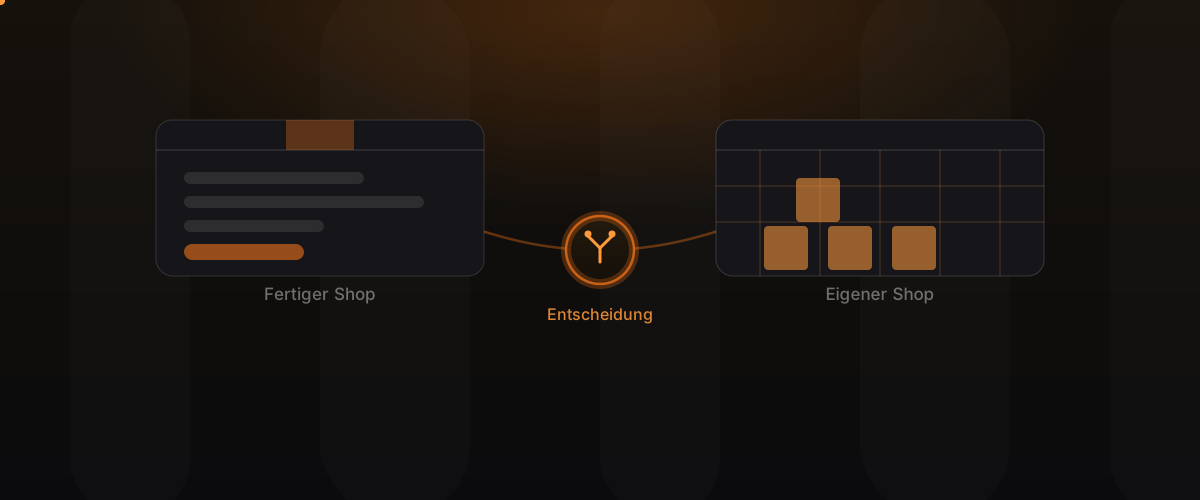
The question comes up in almost every shop project sooner or later: do we take a ready-made platform like Shopify, or do we build something of our own? The honest answer is that both paths can be right, depending on your situation. A well-founded platform decision is not a matter of belief or taste, but a sober weighing of goals, requirements and costs over several years. This article gives you a fair framework for exactly that, without talking down either side.
Key takeaways
- A SaaS platform like Shopify is strong when you want to launch fast and have standard requirements.
- A custom or headless shop pays off with scale, special requirements and deep integrations.
- What matters is not the upfront cost, but the total cost over several years.
- Hybrid paths combine both worlds: buy the standard functions, build what sets you apart.
What the decision is really about
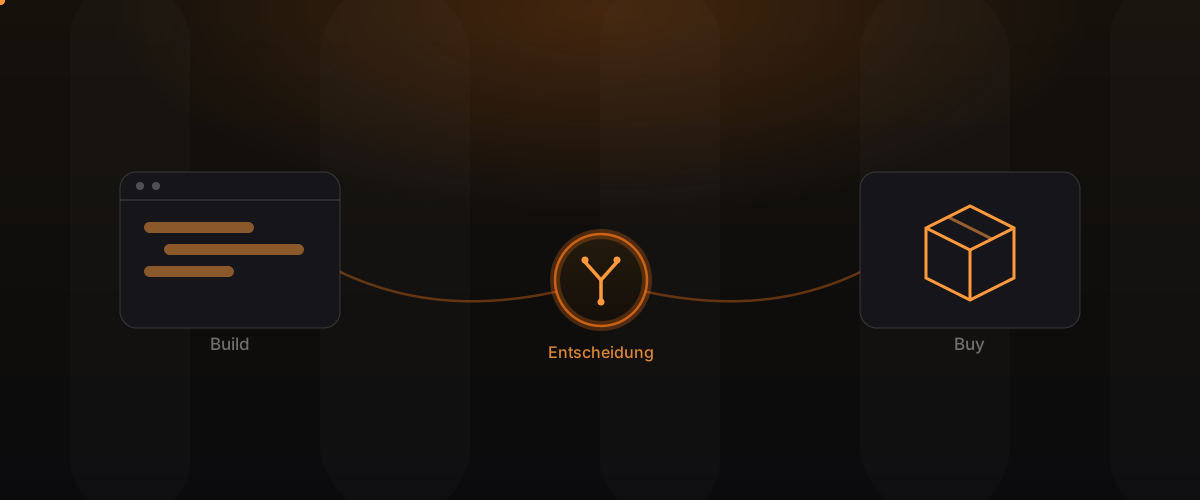
Choosing between a platform and a custom build is a special case of the classic /en/blog/build-vs-buy/ question. It is not about which technology is objectively best, but about which path makes the most sense for your business, your team and your time horizon. A small brand shop with clear products has different needs than a manufacturer with complex configurators, several countries and a connected inventory system.
Answer this question well and you save yourself expensive corrections later. Decide it from the gut and you often pay twice: once for the first solution and once for replacing it.
When a ready-made platform is the right call
Let us be fair: platforms like Shopify are this successful for good reason. They take a large share of the technical work off your plate and get an online store running in a short time. A SaaS solution plays to its strengths in particular when the following applies:
- Time to market matters: you want to sell fast, not develop for months.
- Your requirements are standard: products, variants, shipping and payment within the usual scope.
- A small or no technical team: you want to focus on marketing, not on servers.
- Maintenance should stay predictable: updates, security and hosting run along in the background.
In these cases a custom build would often be more expensive and slower, without delivering real added value. Using a good tool is not a weakness, it is a smart decision.
When a custom or headless shop pays off
There is a point at which the ready-made platform turns from an accelerator into a corset. That rarely happens at the start, but it happens regularly with growth. A custom or headless build pays off when several of the following points apply:
- Special requirements: complex pricing logic, configurators, B2B workflows or unusual checkouts.
- Deep integrations: ERP, PIM, CRM or an existing inventory system that needs to be connected cleanly.
- Scale and performance: high loads, many products or strict demands on loading time and conversion.
- Full control over the frontend: a shopping experience that clearly sets you apart from competitors.
This is not about technology for its own sake, but about a platform no longer slowing down your ambitions. For more on how a decoupled frontend works, see the article on headless commerce.
Transaction fees and the lock-in factor
Two topics tend to get overlooked in the first wave of enthusiasm, but they make themselves felt over the long run. The first is transaction fees: some platforms earn a cut on every sale, on top of the monthly fee. At low revenue that barely registers. As revenue grows, it becomes a noticeable, permanent deduction from your margin.
The second is lock-in: the deeper you work yourself into a closed ecosystem of themes, apps and interfaces, the harder a later switch becomes. That is not an argument against platforms, but a reason to ask the question early: what would it cost us if we wanted or had to move in three years?
Calculating total cost of ownership honestly
The most common mistake is to look only at the purchase. A platform seems cheap because the start is cheap. A custom build seems expensive because the first invoice is higher. But what matters is the total cost over several years (total cost of ownership), and that is made up of several items:
- Ongoing platform and app fees, often monthly and rising over time.
- Transaction fees, which grow with your revenue.
- Development and customization costs, one-off with a custom build, ongoing with platform workarounds.
- Maintenance and operations, visible with a custom build, hidden in the SaaS price.
Only when you set these items against each other over a realistic period does the decision become honest. Sometimes the platform wins clearly, sometimes the math tips toward the custom build as revenue grows.
Shopify and friends vs. a custom shop: the honest comparison
| Criterion | Ready-made platform (e.g. Shopify) | Custom / headless shop |
|---|---|---|
| Time to market | very fast | longer, but tailored |
| Upfront cost | low | higher |
| Ongoing fees | monthly, sometimes transaction fee | hosting and maintenance, no revenue share |
| Special requirements | limited, via apps | almost anything possible |
| Integrations | standard fine, special ones costly | deep and clean to connect |
| Control and lock-in | less control, stronger lock-in | full control, no lock-in |
| Ideal for | standard shops, fast start | scale, special cases, differentiation |
Hybrid paths: the best of both worlds
The decision is rarely a pure either-or. A common and often smart middle path is the hybrid approach: you use the strengths of a platform where standard is enough, for example for checkout, payment or inventory, and you build exactly the parts that set your business apart yourself.
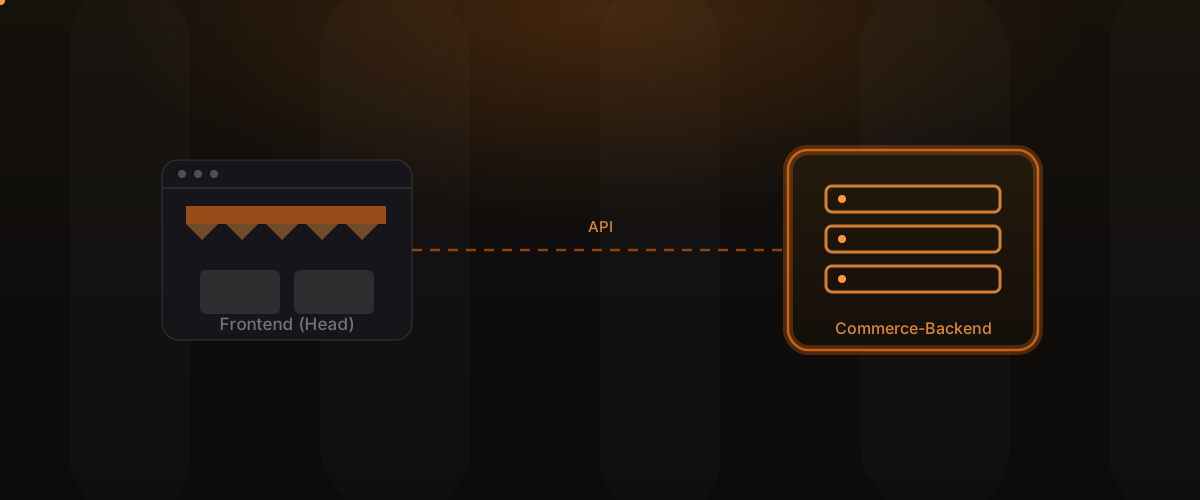
A headless build is often the key here. The backend of a platform handles the heavy routine work, while you build your own fast frontend that fits your brand and your requirements precisely. This way you avoid reinventing the wheel, without locking yourself entirely into a closed system at the same time.
Common mistakes in the decision
From many projects we know the same recurring pitfalls. Knowing them makes them easier to avoid:
- Comparing only the starting price: ongoing costs and fees decide over years, not the first month.
- Starting too big: an elaborate custom build for a shop that still has to prove it brings revenue.
- Waiting too long: clinging to a platform even though it has long been slowing down your growth.
- Ignoring migration: not clarifying what a later switch would look like, should it become necessary.
Most of these mistakes do not come from ignorance, but from the wish for a quick, simple answer. A good decision needs a little more groundwork, but it saves a lot of money in return.
How we make the decision together
We approach the question in a structured and open-ended way, not with a ready-made opinion in mind:
- Clarify requirements: products, processes, integrations and realistic growth goals.
- Model scenarios: total cost over several years for platform, custom build and hybrid paths.
- Assess risks: lock-in, fees, maintenance effort and a possible later migration.
- Give a recommendation: clearly reasoned, even when the platform is the right choice.
The result is a decision you can understand and stand behind, because the reasons are on the table and not hidden in the technology.
Frequently asked questions
Is Shopify bad? No. Shopify and similar platforms are excellent tools for many shops. For a fast start with standard requirements they are often the best choice. The question is not good or bad, but a fit or a misfit for your case.
When should I think about a custom shop? As soon as special requirements, deep integrations or transaction fees become noticeable and the platform slows down your growth. That is usually not at the start, but from a certain size onward.
What is a headless shop? A setup where the frontend (what customers see) is separated from the backend (where products and orders live). This lets you build a fast, custom shopping experience, often combined with a proven platform in the background.
Can I switch from Shopify to a custom shop later? Yes, a switch is possible, but it requires planning. Data, content and redirects have to be carried over cleanly. That is exactly why it pays to consider the migration question early.
Is a custom shop worth it for small businesses? Usually not from the start. For small shops with standard requirements a platform is often cheaper and faster. A custom build becomes interesting when special requirements or scale come into play.
What does a custom shop cost? That depends on the scope, every project is individual, so pricing is on request. More important than the starting price is comparing the total cost over several years against a platform.
Conclusion
There is no universally right answer, only the right answer for your case. A ready-made platform is strong for a fast start and standard requirements, a custom or headless shop for scale, special cases and differentiation. What matters is an honest calculation over several years, not the first impression.
To see how we build shops, visit E-Commerce Engineering; for ready-made platforms and SaaS, SaaS Engineering is a good fit. The underlying framework is in Build vs. Buy: build it yourself or buy?.